


Consulting ...
‘Looking at team management through the lens of professional competence is not sufficient in the age of the so-called knowledge worker and does not meet the ever-increasing requirements of 21st century organisations.
In addition to a high intelligence quotient, a university degree and high professional qualifications, an essential component for building leadership authority is emotional intelligence.
It is what ensures professional effectiveness, enables conflict-free teamwork and the ability to initiate and accept change.’
– Daniel Goleman
‘Emotional Intelligence in Practice’.
In our work, we rely on diagnostic tools that allow us to evaluate the effects of the coaching process in a measurable way. In order to precisely identify areas for development, we use in our work, in addition to the in-depth behavioural interview (BEI), a 360-degree survey, which, depending on the coaching objectives and the client’s requirements, diagnoses emotional or professional competences.
Evidence-based coaching is a method of working with both individual and group clients that goes beyond standard coaching approaches (executive, personal, life coaching) based on current knowledge from the social sciences to support the process of individual behavioural change.
The most common professional areas in which coaching work is recommended are:
Implementation of a new leader into the organisation
Career development and related so-called role conflict in a new position
Manager’s underperformance with the team
Counteracting professional burnout
Increasing number of personal conflicts and related deteriorating work atmosphere
Decreased sense of own achievement and empowerment in one’s position
Decreasing commitment to work and identification with company goals
Team building
Development of assertive behaviour
Executive Coaching Process
Cooperation with a coach would be offered to the company’s management and would be aimed at the development of specific competencies, defined in a tripartite process involving the supervisor, the programme participant and the coach. On the basis of the meeting, a document will be drawn up specifying the objectives of the coaching cooperation, together with measures of effectiveness, its time dimension and the rhythm of meetings.
Each meeting will take place face-to-face or face-to-zoom, depending on the participant’s capabilities and preferences.
The collaborative coaching process for one participant is planned for a maximum of 7 sessions. The methodology for conducting the sessions will be adapted to the participant’s profile and preferences, as well as to the objectives set. Between sessions, the participant will incorporate specific developmental tasks into daily managerial practice to work in the defined developmental area.
An additional tool to support the coaching process will be a Personal Reflection Journal kept by the participant during the programme.

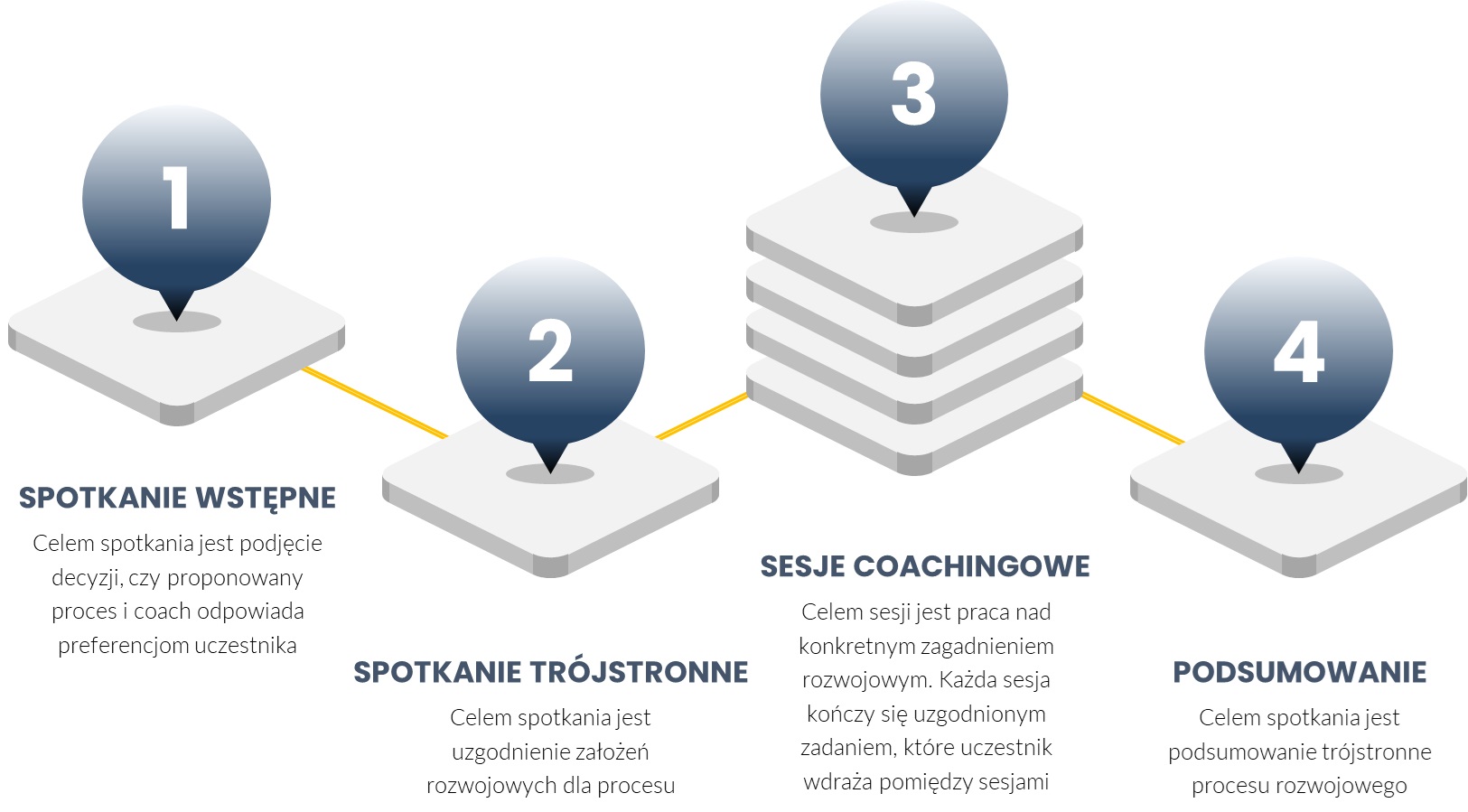
At the end of the coaching process, a memo will be drafted for the HR Department and the supervisor summarising the process and including developmental guidance.
The slide shows the proposed content model on which the development process would be based.
Feedback 360
Diagnosis of the manager’s actual level of authority in the team
- Is the manager’s self-assessment consistent with that of the employees, or is it significantly different?
- What builds the supervisor’s ‘power’ in influencing his or her team – his or her actual authority and respect among employees or the formal authority derived from his or her position?
- Do employees work more for the supervisor or more for themselves?
- Are employees interested in their supervisor’s success or perhaps in his or her failure?
- Diagnose the quality of leadership in the department/pioneer and, on this basis, develop the necessary directions for development programmes dedicated to its manager
- What are the manager’s strongest points according to his/her people and what are his/her weakest points?
- What behaviours are subordinates missing from their manager?
- Diagnosis of development needs for the manager and better alignment of development cues with the manager’s actual needs.
- Diagnosis of the dominant leadership style
- Using the Harvard School’s Buissness leadership model to identify a manager’s preferred leadership style
- Defining whether these preferences are based on constructive (long-term) or perhaps destructive (short-term) styles
- Establishing individual directions for changing the attitudes and behaviours preferred/used so far
- Recognise the consequences of using directive and non-communicative styles
- Understand the long-term consequences of not using constructive styles
Motivation audit
General diagnosis of the level of motivation and morale of employees in the department/division/company – compared to the aggregate score of all surveyed departments/divisions in the Company
- How ‘healthy’ is my department/level? Are there a preponderance of motivated or low commitment employees?
- Do people enjoy working together, do they feel like ‘one family’, is there a synergy effect?
- Is my unit better or worse off than the average in the corresponding market? –
- What are the reasons for this?
- What causes this condition and how can it be eliminated?
- Do the reasons lie with the manager or are they beyond his or her control?
- Will additional results have to be ‘bought in’ from employees individually or are they able to become more involved because they identify with the team/department/company?
Identifying areas of satisfaction that motivate employees and make them want to have a long-term relationship with the Company. A high level of employee satisfaction has a direct impact on their work commitment, creativity, identification with the organisation and on the measurable level of their production
- What do employees value most and what binds them most strongly to the Company? Money or perhaps other elements?
- What is it that causes them not to leave even with more attractive offers from the market?
With knowledge of the employees’ actual motivations, the manager will be able to use the language of benefits much more accurately when communicating with them. Identify areas of frustration and dissatisfaction that hinder work, reduce its quality and demotivate employees.
- Which manager’s actions are perceived negatively by employees?
- Which practices in the department/pioneer (bonuses, commission levels, client allocation, etc.) are questioned by employees and subject to their critical discussions (e.g. in the so-called kitchen)?
- What might cause valuable employees to start looking for alternatives in the market?
Identification of relationships between employees where managerial intervention is required.
Being able to detect conflict situations in their early stages before they develop into open confrontation.
- Whether the behaviour of some of the employees is demotivating to the rest of the workforce (aggression, vocabulary, unethical behaviour, exploitation of personal relationships for business purposes, etc.).
Symlog Study
The Symlog method versus the traditional 360-degree assessment – is it worth investing in a new approach to vetting and capacity building among middle and senior managers?
Advantages and limitations of the 360-degree survey, i.e. what is missing in its results to be considered an excellent tool.
The genesis of the SYMLOG approach, its key dimensions and the types of unique information obtainable through the various reports, e.g:

- A unique opportunity to diagnose the dynamics of relationships within teams, i.e. what attitudes all, individual team members have towards each other (linking 360 individual images into a network of their interactions and interactions)
- Possibility of diagnosing the strength of integration of a given team, or possibly identifying the number of informal subgroups and their potential leaders
- Analysis of the strength of a particular manager’s leadership and his or her ability to motivatingly activate the actions of subordinates
- An inventory of initiatives that should be implemented for each team member in order to achieve a stronger integration of the whole structure
Developmental aspects of the information obtained and the value of the feedback carried out on the basis of this information in building corrective plans or improvement actions.
The benefits for the team being diagnosed and the organisation as a whole of using the SYMLOG approach.
Competence profiles
In order to give an idea of the specifics of our approach, it seems necessary to present how we define the key concepts for counselling activities.
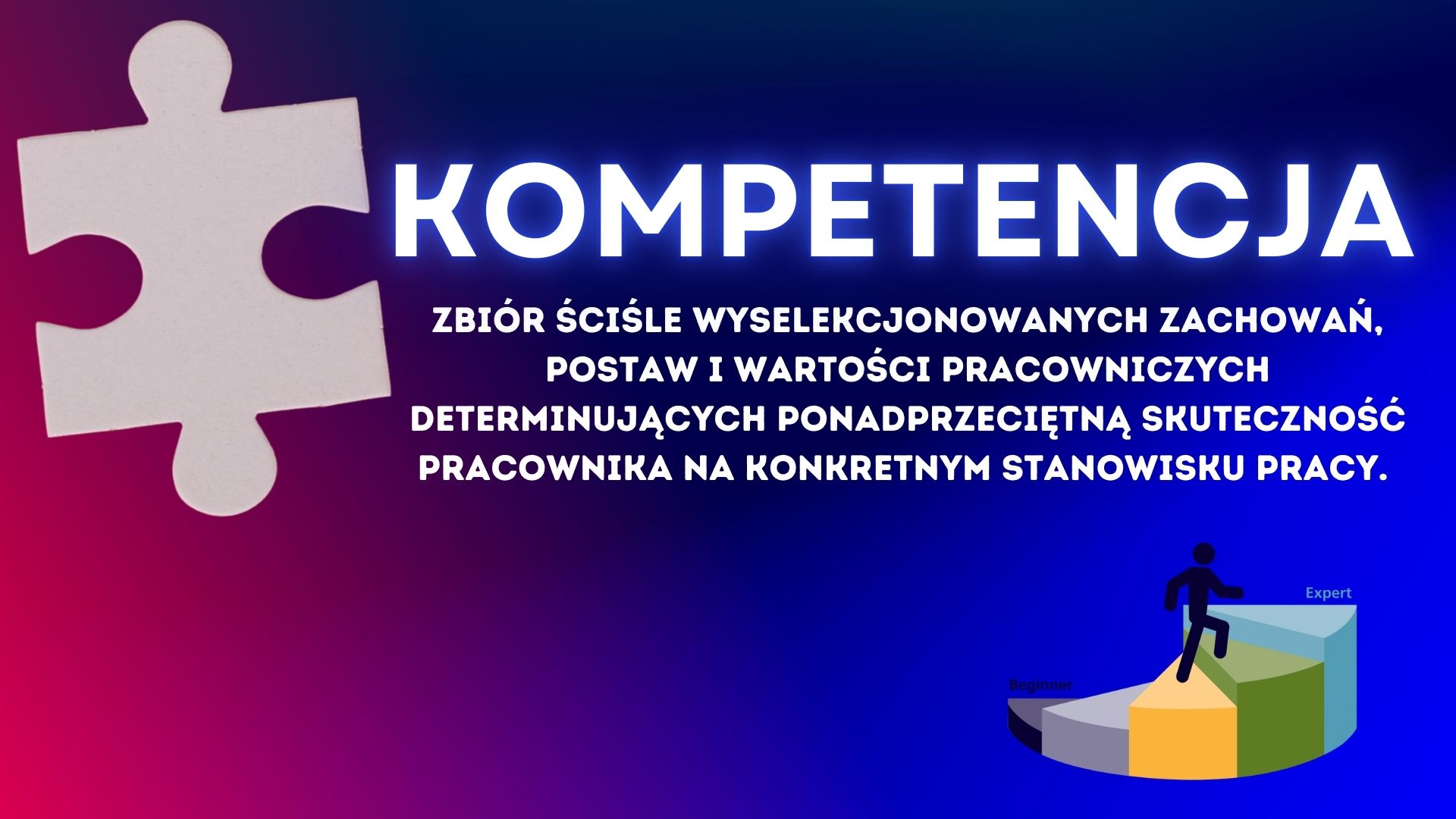
Competence – is a set of strictly selected behaviours, attitudes and employee values that determine the above-average effectiveness of an employee on a specific job position.
An aspect that is often underestimated when defining competencies, is the precise capture of those dimensions that differentiate outstanding from average or even poor employees. It turns out that in most organisations, some of the competences are demonstrated by all the above-mentioned groups, often even with a similar degree of intensity. Tools built on such a basis not only do not guarantee bringing new, desired by the customer, quality to the organisation, but they even deepen the phenomena/problems the organisation is trying to cope with.
A model competence is a behavioural dimension, i.e. a description of specific, measurable behaviours and attitudes that can be grasped (and assessed) through direct observation. In colloquial terms, it should not direct the managers using it to make hypotheses as to ‘what a person is like in the depths of his or her mind and what can drive him or her’, but rather to make judgements – about his or her predispositions or lack thereof – by observing how he or she functions and behaves in specific situations.
Model-defined competence is also a discontinuous dimension. This means that so-called levels can be distinguished within it. Each level determines attitudes and behaviours specific only to it. Qualifying for a higher level means demonstrating new attitudes and behaviours qualitatively different from the level below it – demonstrating the same behaviours but with greater intensity does not fulfil this condition (figuratively speaking, levels are successive rungs in the excellence of the use of a dimension). To qualify for a higher level, the new aspects of professional functioning must be permanent, established and observable in practically all professional situations in which they play a key role.
Job profile – means the set of competences defined for it (meeting the criteria of the term ‘competence’ made above), together with their levels. It is often the case that a given (same) competence characterises an outstanding employee and an average or weak one. What may differentiate them, however, are the levels of its demonstration.
The work usually takes place in four stages:
- Stage 1 – Expert panels
- Stage 2 – Behavioural interviews
- Stage 3 – Verifying expert panels
- Stage 4 – Behavioural navigator
Andrzej is ...
Executive Coach and Leadership Trainer with over 34 years of professional experience in the field of Sales Management and Human Resources Development. A member of the Forbes Coaching Council, the Chamber of Coaching in Poland, and the Polish ISTDP Association.
For over 22 years she has specialized in creating and leading development programs supporting both corporations and individual clients in the area of relationship building based on emotional competencies.
